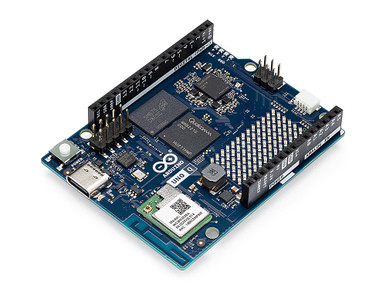
Arduino UNO Q 2GB
Roll over image to zoom in
$ 39.60
Arduino ABX00162 - Arduino UNO Q bridges high-performance computing with real-time control, supporting advanced applications such as object recognition, voice commands, motion detection, and more. Get power and ease of use – all wrapped up into UNO. Arduino UNO Q’s hybrid design makes it the perfect dual-brain platform for your next innovation. It combines a Linux® Debian-capable Qualcomm® Dragonwing™ QRB2210 microprocessor with a real-time STM32U585 microcontroller (MCU). It’s Arduino, it’s a computer, it’s anything you want to build. It’s the go-to tool to prototype your next robotics or IoT project, thanks to: All-in-one toolbox: Arduino UNO Q combines the powerful Qualcomm® Dragonwing™ QRB2210 microprocessor (MPU) with a real-time STM32U585 microcontroller (MCU) – no matter what you’re building, it’s your new go-to tool! AI in a blink: unlock AI-powered vision and sound solutions that react to their environment. Arduino support and developer tools including libraries, sketches, and projects developed for the UNO ecosystem by millions of users. Compatible with the Arduino UNO ecosystem: UNO Q works with a wide range of Arduino hardware, from classic UNO shields to new carriers, and includes a Qwiic connector for Modulino® nodes and third-party modules. Streamlined software experience: in addition to Arduino IDE and Arduino Cloud, you can jumpstart development with plenty of pre-built examples and AI models available through Arduino App Lab. Seamless, unified development: build classic Arduino Sketches, code in Python® thanks to the pre-installed Linux® Debian OS, or mix the two from a single interface – it’s easy, with Arduino App Lab. Powered by Qualcomm Dragonwing QRB2210 Your UNO Q is a compact, cost-effective platform with advanced features like machine vision – thanks to the integrated AI and GPU acceleration, quad-core 2.0 GHz CPU, Adreno GPU, 2x ISP, and support for camera, display, and audio provided by the Dragonwing QRB2210. Advanced features Microprocessor: Qualcomm® Dragonwing™ QRB2210 Microcontroller: Real-time, low-power STM32U585 MCU RAM: 2GB LPDDR4 Storage: 16 GB eMMC built-in (no SD card required) Connectivity: Dual-band Wi-Fi® 5 (2.4/5 GHz), Bluetooth® 5.1 High-speed headers: Power advanced peripherals – vision, audio, display Classic UNO headers: Mount shields to add capabilities LED matrix: 8 x 13 LED matrix for visual creation and feedback USB-C connector: Power delivery, video output, or connect keyboard, mouse, USB microphones or USB cameras via dongle Qwiic connector: Expand easily with Modulino® nodes – no soldering required UNO Q empowers innovators to turn ideas into real-world solutions. Whether you’re experimenting with IoT, learning robotics, or diving into AI, your next idea starts with Q. Tech specs Microprocessor (MPU) Qualcomm Dragonwing™ QRB2210:Quad-core Arm® Cortex®-A53 @ 2.0 GHzAdreno GPU 3D graphics accelerator2x ISP (13 MP 13 MP or 25 MP) @ 30 fps Microcontroller (MCU) STM32U585Arm® Cortex®-M33 up to 160 MHz2 MB flash memory786 KB SRAM RAM 2GB LPDDR4 Power Supply From USB-C connector 5 V max at 3 AInput Voltage (VIN): 7-24 V Storage 16GB eMMC USB 1× USB-C port with host/device role switching, power role switch and video output Connectivity Wi-Fi® 5 2.4/5GHz with onboard antennaBluetooth® 5.1 with onboard antenna Interfaces I2C/I3CSPIPWMCANUARTPSSIGPIOJTAGADC Video Video output support via USB-CMIPI DSI pins on JMEDIA header Extra 4× RGB user-controllable LEDs8x13 Blue LED Matrix1x Qwiic connector voltage 3V3, I2C1x User push-buttonJCTL: MPU Remote Debug connector Audio Microphone IN / Headphone OUT / Line OUT on JMISC Dimensions 68.85 mm x 53.34 mm (UNO form factor) MPU Operating System Linux Debian OS with upstream support Real-time Operating System Arduino Core on Zephyr OS Containerization Docker and Docker Compose support Support Operating Systems for Arduino App Lab Windows: Windows 10 or later (64-bit)macOS: macOS 11 or later (64-bit)Linux: Ubuntu 22.04 or later, and Debian Trixie (64-bit) Documentation DATASHEET IN .PDF